Can ctDNA Detect Triple-Negative Breast Cancer Recurrence Before Scans? The PREDICT-RD Trial
By: David Grew MD MPH
"The PREDICT-RD Trial is studying whether MRD testing can detect cancer recurrence before it appears on scans."
For some patients with triple-negative breast cancer, treatment does not end with surgery.
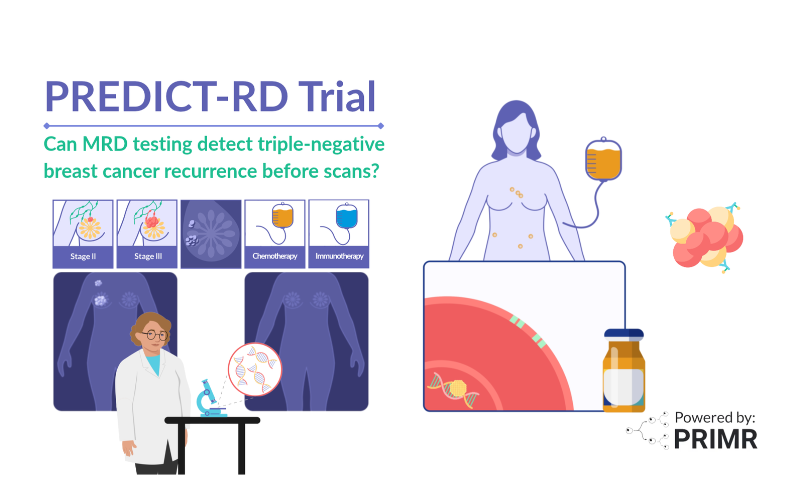
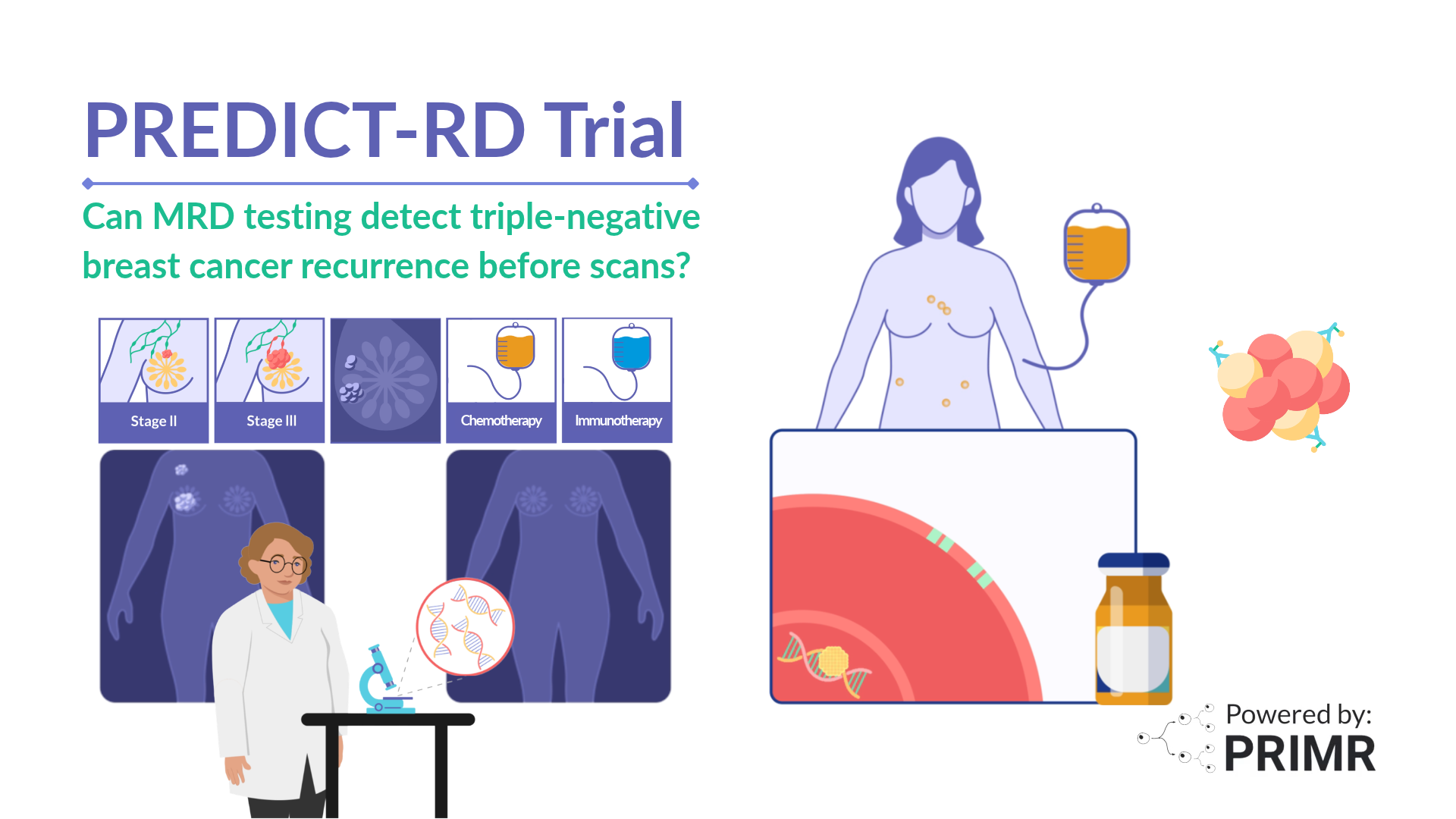
Patients with stage 2 or stage 3 triple-negative breast cancer may first receive chemotherapy and immunotherapy, followed by surgery. When cancer cells are still found in the tissue removed at surgery, this is called residual disease. Residual disease means the cancer did not completely respond to treatment before surgery and may be associated with a higher chance of the cancer returning.
The PREDICT-RD Trial is studying whether a blood test can help identify signs of recurrence earlier—before cancer can be seen on imaging scans.
The study uses circulating tumor DNA, or ctDNA, to look for what is called molecular residual disease, or MRD. Researchers are also studying whether patients with a positive MRD test but no cancer visible on scans may benefit from treatment with datopotamab deruxtecan, also called Dato-DXd.
Why is residual disease important in triple-negative breast cancer?
Triple-negative breast cancer, or TNBC, is a type of breast cancer in which cancer cells have little or none of three key receptors on their surface. Because of this, TNBC is treated differently from some other breast cancers.
For many patients with stage 2 or stage 3 TNBC, chemotherapy and immunotherapy are given before surgery. The goal is to shrink the cancer and begin treating cancer cells as early as possible.
After surgery, doctors examine the removed tissue to see how much cancer remains.
If cancer cells are still present, this is called residual disease. It shows that the cancer did not completely respond to the treatment given before surgery. For these patients, one important question is whether cancer cells may still remain elsewhere in the body even when scans appear normal.
What is molecular residual disease?
Cancer does not always become visible on a scan immediately. A very small amount of cancer may still be present in the body even when routine imaging shows no evidence of disease. This is sometimes called molecular residual disease, or MRD.
One way to look for MRD is through a blood test that detects ctDNA, which consists of tiny pieces of cancer DNA that can enter the bloodstream when cancer cells break apart. Finding this DNA may provide a clue that cancer cells are still present even when there is not yet enough cancer to be seen on imaging.
This is the central idea behind PREDICT-RD.
How does the PREDICT-RD Trial use ctDNA testing?
Patients in the study have blood tests at regular intervals to look for molecular residual disease.
While patients are receiving treatment after surgery, MRD testing is performed about every six weeks. After treatment is completed, testing is performed about every 12 weeks during follow-up.
If no cancer DNA is detected, patients continue to be followed in the study.
If the blood test becomes positive, patients undergo imaging to look for signs that the cancer has returned.
This creates an important opportunity for researchers to compare what is detected in the blood with what can be seen on scans.
What happens if ctDNA is detected but scans are still negative?
This is one of the most important questions PREDICT-RD is designed to study.
If ctDNA is detected but scans do not show recurrent cancer, it may mean that cancer cells are present at a level that is still too small to see with imaging.
There is currently no standard approved approach described in the study for this situation.
Patients in this group may have the option to receive Dato-DXd.
Dato-DXd is already an approved treatment for patients with metastatic triple-negative breast cancer. In PREDICT-RD, researchers are studying whether it may also be useful earlier, when a blood test shows molecular residual disease but imaging still does not show cancer.
What does treatment with Dato-DXd involve?
Patients who receive Dato-DXd in the study receive it through an IV once every three weeks.
Treatment may continue for up to eight treatments, or approximately six months.
Treatment may be stopped earlier if cancer becomes visible on scans, if side effects become too serious, or if the patient decides to stop treatment.
The goal is to learn whether treating cancer at this molecular stage may help delay or prevent a later recurrence that can be seen on imaging.
What are researchers hoping to learn?
PREDICT-RD is studying both detection and treatment.
Researchers want to learn how often MRD testing can identify signs that cancer may be returning before it becomes visible on scans.
They will also study the safety of Dato-DXd and whether treating patients with positive MRD but negative imaging may help delay or prevent the cancer from returning.
The study also looks beyond medical test results.
Patients complete surveys about quality of life, anxiety, and fear of cancer recurrence. This will help researchers understand what it is like for patients to receive information about molecular residual disease, especially when a blood test suggests cancer may be present but scans remain normal.
Why could this approach matter?
One of the challenges after treatment for triple-negative breast cancer is knowing which patients may still have cancer cells remaining in the body.
PREDICT-RD is exploring whether repeated ctDNA testing can provide a more personalized way to monitor patients with residual disease after surgery.
If molecular residual disease can be identified before cancer appears on scans, it may create an earlier opportunity to recognize patients at higher risk of recurrence.
The study is then taking the question one step further by asking whether treatment at that earlier stage may make a difference.
Who may be eligible for the PREDICT-RD Trial?
Patients may be able to participate if they have stage 2 or stage 3 triple-negative breast cancer, received chemotherapy and immunotherapy before surgery, and still had cancer cells in the tissue removed at surgery.
Patients in the study are followed for up to three years.
As with any clinical trial, there may or may not be a direct benefit to an individual patient who participates.
–
The PREDICT-RD Trial is testing a different way of thinking about cancer recurrence.
Instead of waiting until recurrent triple-negative breast cancer can be seen on a scan, researchers are studying whether ctDNA testing can identify molecular signs of cancer earlier.
For patients whose blood test becomes positive while imaging remains negative, the study is also exploring whether treatment with Dato-DXd could help delay or prevent the cancer from returning.
The results may help doctors learn whether a more personalized approach to monitoring and treating triple-negative breast cancer after surgery can improve care for future patients.
To learn more about the PREDICT-RD clinical trial, watch the video we made here.
To learn more, browse our library of breast cancer-related topics.
Hire PRIMR to create custom video content for your clinical trial or medical product today.
FAQs:
Does a negative ctDNA test guarantee that my cancer will not come back?
No. A negative result means that the test did not detect the cancer DNA it was looking for at that time. It does not guarantee that no cancer cells remain or that recurrence will never happen. In PREDICT-RD, ctDNA testing is repeated over time for this reason. If you have questions about how to interpret a negative result, talk with your cancer care team.
Does a positive ctDNA result mean cancer will already be visible on a scan?
No. ctDNA testing can detect molecular evidence of cancer that may not yet be visible on imaging. In PREDICT-RD, patients with a positive ctDNA result undergo scans to look for detectable recurrence. Your study team can explain what a positive result means and what additional evaluation is needed.
Is ctDNA testing the same as inherited genetic testing?
No. ctDNA testing looks for DNA shed by cancer cells into the bloodstream. Inherited genetic testing looks for genetic changes a person was born with. These tests answer different questions. If you are unsure which type of testing you are having, ask your care team to explain the purpose of the test.
Is Dato-DXd already approved for triple-negative breast cancer?
Yes, for certain patients with unresectable or metastatic TNBC. Its use in patients who have molecular residual disease but no cancer visible on scans is different and is being studied in PREDICT-RD. If Dato-DXd is being discussed as part of the trial, ask the study team about the potential benefits, risks, and uncertainties in this setting.
Can I choose to stop participating in PREDICT-RD?
Yes. Participation in a clinical trial is voluntary. If you are considering stopping, talk with the study team and your regular oncology team so they can explain what that would mean for your testing, treatment, and follow-up care.
Other Posts