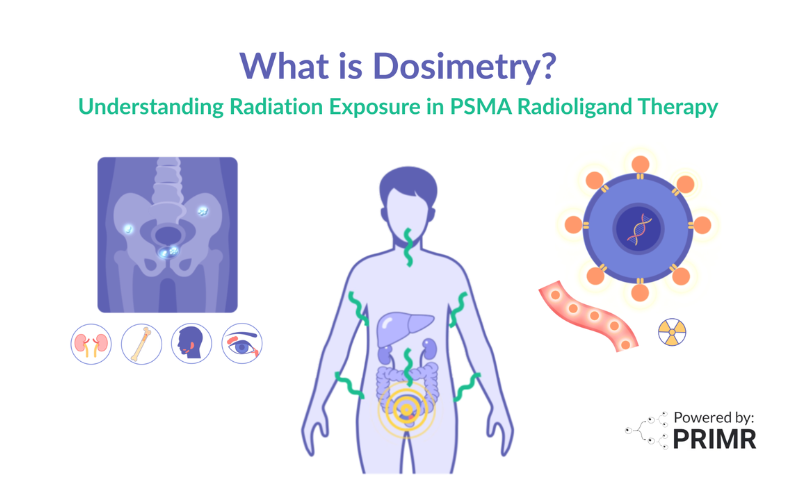
What Is Dosimetry? Understanding Radiation Exposure in PSMA Radioligand Therapy
.png)
By: David Grew MD MPH
"Dosimetry is the science of measuring where radiation actually goes after treatment."
∗ ∗ ∗
As radioligand therapy, or RLT, becomes a bigger part of advanced prostate cancer care, one term is coming up more often: dosimetry.
Dosimetry is the measurement of how much radiation is absorbed by different tissues after a radioactive treatment is given. It is typically reported in a unit called Gray (Gy). In simple terms, dosimetry helps doctors understand where the radiation went, how much reached the tumor, and how much reached healthy organs.
That matters because PSMA radioligand therapy is designed to deliver radiation to prostate cancer cells, but no treatment is perfectly selective. Some radiation can also reach normal tissues. Dosimetry helps describe that balance.
How PSMA radioligand therapy works
PSMA has become an important target in prostate cancer. A PSMA PET scan can help show where PSMA-avid prostate cancer cells are located in the body, and PSMA-targeted radioligand therapy uses that same general idea for treatment. A targeting molecule binds to PSMA, and a radioactive payload is attached to it. The goal is to deliver radiation to cancer cells that express PSMA.
When more of that activity localizes to tumor sites, it contributes to tumor dose. When it localizes elsewhere, it contributes to normal-organ dose. That is why dosimetry matters so much in this setting.
What dosimetry is really measuring
A simple way to think about dosimetry is this: it is not just about the amount of drug administered. It is about the absorbed radiation dose over time.
Two patients may receive the same treatment activity but still have different radiation exposure to tumors and healthy organs. That can happen because the treatment does not distribute through the body in exactly the same way for every person. Dosimetry helps capture that patient-to-patient variability.
Why off-target dosimetry matters
People often focus on how much dose reaches the cancer. That is important, but dose to healthy tissue matters too.
With PSMA radioligand therapy, measurable radiation exposure can occur in normal tissues, including the lacrimal glands, salivary glands, kidneys, and bone marrow. FDA prescribing information for Pluvicto reports that the organs with the highest absorbed doses include the lacrimal glands, salivary glands, kidneys, and urinary bladder wall. FDA review documents also discuss salivary glands, lacrimal glands, kidneys, and bone marrow as organs at risk in PSMA radioligand therapy.
This is one reason dosimetry is so clinically relevant. It can help the care team think ahead about tolerability, monitoring, and possible side effects.
Why healthy tissues can still be exposed
There are two broad reasons healthy tissues may receive radiation.
One is that some normal tissues show physiologic PSMA expression, meaning the targeting molecule may bind there too. Another is that some radioligand can remain in the circulation before it binds to tumor, contributing to systemic off-target exposure. PSMA is found on many prostate cancer cells but also on some healthy cells.
That does not mean the treatment is “missing the target.” It means the biology is more complex than a simple on-off switch.
How dosimetry is estimated
In practice, dosimetry is often estimated using post-treatment imaging. One commonly used method is SPECT/CT, which can help show where radioactivity is distributed after a treatment cycle. Professional nuclear medicine materials describe post-therapy imaging as an important tool for estimating absorbed dose and supporting more personalized care.
The goal is not to produce a single perfect number that predicts exactly what will happen for every patient. The goal is to create a measurable link between:
- administered activity
- biodistribution
- absorbed dose
- and possible clinical effects
How dosimetry may help the care team
Dosimetry can help support several parts of care.
It may help teams:
- better understand radiation exposure to tumors and organs
- anticipate possible toxicity
- guide patient counseling
- support monitoring during treatment
- think more carefully about supportive care needs over time
This is especially useful because radioligand therapy is a balancing act. The ideal is to maximize tumor dose while limiting radiation to healthy tissue.
What this means for patients
For patients and families, dosimetry is one more way medicine is becoming more individualized.
It does not mean every patient will need an elaborate personalized calculation before every treatment, and it does not guarantee that side effects can be predicted perfectly. But it does give the care team a more structured way to think about where radiation is going and what that may mean for both benefit and risk.
In prostate cancer radioligand therapy, that is especially important because treatment decisions are often about balance: treating cancer effectively while protecting normal organs as much as possible. Ongoing research is aimed at making those predictions better and, over time, may support more personalized dosing strategies.
–
Dosimetry may sound technical, but the basic idea is straightforward. It is the science of measuring where radiation actually goes after treatment.
In PSMA radioligand therapy, that matters because tumor uptake is only part of the story. Healthy tissues matter too. Understanding dosimetry can help care teams better monitor patients, anticipate side effects, and continue improving how these therapies are used.
–
To learn more, watch this video we produced in partnership with Curium Pharma on Understanding Dosimetry.
To learn more about PSMA, watch our dedicated 4-part series: Part 1 | Part 2 | Part 3 | Part 4
Hire PRIMR to create custom video content for your clinical trial or medical product today.
FAQs:
Is dosimetry the same thing as the treatment itself?
No. Dosimetry is the measurement of how much radiation different tissues absorb after a radiopharmaceutical is given. It helps describe dose to tumors and to normal tissues, usually in units of Gray. If you are receiving radioligand therapy, ask your care team whether dosimetry is part of how your treatment is being monitored.
Can healthy organs receive radiation during PSMA radioligand therapy?
Yes. Healthy tissues can receive radiation exposure during PSMA radioligand therapy, and organs such as the salivary glands, lacrimal glands, kidneys, and bone marrow are commonly discussed as organs at risk. That is one reason side-effect monitoring is so important. If you notice dry mouth, eye symptoms, unusual fatigue, or other new problems during treatment, contact your care team.
Do all patients absorb the same radiation dose if they receive the same treatment amount?
No. Dosimetry helps show that absorbed dose can vary from one patient to another, even when the administered activity is the same. That is because the radioligand does not distribute through every body in exactly the same way. If you want to understand how individualized your care is, ask your team how they follow response and organ safety over time.
Is PSMA PET imaging part of deciding whether PSMA radioligand therapy is appropriate?
Yes. Patient selection for Pluvicto has been tied to approved PSMA PET imaging that shows PSMA expression in tumors. In practical terms, that means PSMA imaging helps determine whether the cancer appears targetable with PSMA-directed therapy. If this treatment is being discussed for you, ask how your PSMA PET results affect that decision.
Can dosimetry perfectly predict who will have side effects?
No. Dosimetry can help estimate organ exposure and improve counseling, monitoring, and supportive care planning, but it does not perfectly predict toxicity for every patient. It is best understood as one useful tool, not a crystal ball. If you are worried about side effects, ask your care team which organs they watch most closely and what symptoms you should report early.
Other Posts
.png)
.png)